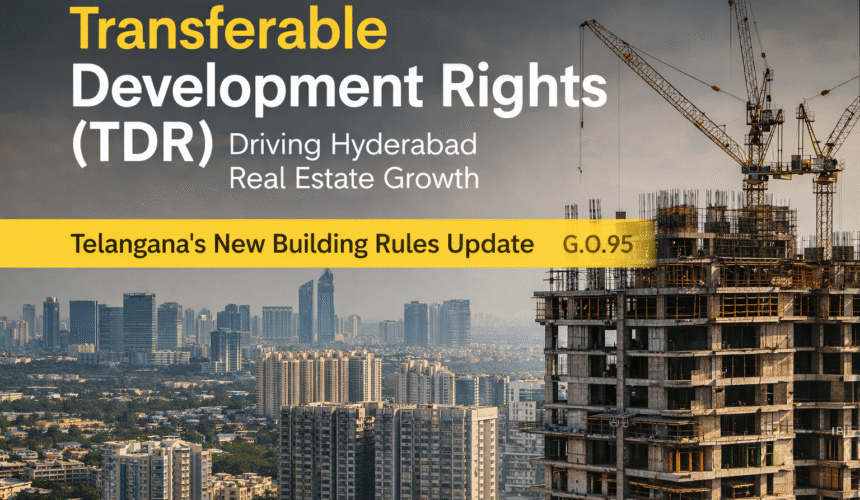
The Telangana government’s amendment to the Building Rules, 2012—especially through G.O. 95—is not just a regulatory tweak. It is a structural shift in how Hyderabad will grow vertically, with Transferable Development Rights (TDR) at the center of this transformation.
What is TDR & Why It Matters
Transferable Development Rights (TDR) is a mechanism that allows developers to purchase additional construction rights from the government or landowners, usually in exchange for land acquired for public infrastructure.
- Helps government avoid cash compensation
- Encourages infrastructure development (roads, lakes, public projects)
- Enables developers to build taller structures
TDR is widely used as a value capture financing tool in cities like Hyderabad to fund urban expansion.
Previous vs Current TDR Rules (Quick Comparison)
| Parameter | Previous Rules | Updated Rules |
|---|---|---|
| High-Rise Definition | Lower threshold | 21 meters+ |
| Mid-Rise Buildings (18–21m) | Limited permissions | Allowed via TDR (750–2000 sq.m plots) |
| Extra Floors | Highly restricted | Up to 5 extra floors based on road width |
| Setback Norms | Strict, non-flexible | Relaxations allowed via TDR |
| TDR Usage | Limited scope | Expanded across multiple aspects |
| TDR Charges | Not structured clearly | 3% (>10 floors), 5% (>20 floors) |
| Payment Structure | Not standardized | 50% at approval + 50% before occupancy |
Key Rule Changes
Based on the latest amendment:
- High-rise definition updated to 21m+
- Buildings 18–21m allowed via TDR (750–2000 sq.m plots)
- Extra floors allowed based on road width (up to 5 floors)
- Setback relaxations via TDR
- TDR mandatory for high-rise developments (>10 floors)
- Cost impact estimated at ₹300–₹400 per sq.ft increase
Quick Summary of G.O. 95
Policy Objective:
- Boost construction activity
- Promote vertical growth
- Improve ease of doing business
Key Mechanisms:
- Mandatory TDR for high-rise projects
- Flexible building norms (height + setbacks)
- Phased TDR payments:
- 50% during approval
- 50% before occupancy
Outcome Expected:
- Higher supply of apartments
- Increased demand for TDR certificates
- Strong push toward high-density development
GHMC Real Estate Impact
Within Greater Hyderabad Municipal Corporation limits, the impact will be immediate. Areas like Kondapur, Madhapur, and Gachibowli already have strong demand but limited land availability. With TDR allowing extra floors and some flexibility in setbacks, developers can get more out of the same land parcel. This will lead to more high-rise projects and premium developments. At the same time, because TDR comes at a cost, property prices in these core areas are more likely to move up rather than soften.
HMDA Growth Corridors & Investment Outlook
In Hyderabad Metropolitan Development Authority zones, the story is slightly different. These areas still have larger land parcels and are seeing steady infrastructure growth. With the new rules, developers can plan bigger, taller projects right from the start instead of upgrading later. Locations like Kokapet and Neopolis are expected to benefit the most. For investors, this means better long-term potential, especially if entering at an early stage before prices fully catch up with the new development potential.
Real Market Insight (What Developers Are Actually Thinking)
👍 Positive
- More flexibility in design
- Ability to unlock premium land potential
- Faster approvals via systems like TG-bPASS
⚠️ Concerns
- TDR costs have increased significantly (even doubling in some cases)
- High-rise projects becoming expensive
- Margin pressure → cost passed to buyers
Impact on Kondapur Real Estate Market
Kondapur is one of the most strategic micro-markets in West Hyderabad, and this policy will have a direct and visible impact.
1. Rise in High-Rise Projects
- Kondapur has proximity to:
- HITEC City
- Financial District
- Developers will now:
- Opt for taller buildings using TDR
- Increase density in existing land parcels
2. Price Movement (Important for Investors)
- TDR adds ₹300–₹400/sq.ft cost
- Developers will pass this to buyers
👉 Expected outcome:
- New launch prices in Kondapur likely to increase
- Resale inventory may also see upward push
3. Supply vs Demand
- Supply will increase due to more floors
- But:
- Demand in Kondapur is already strong (IT workforce)
👉 Result:
- Prices will not fall significantly, may stabilize or rise
4. Investment Insight for Kondapur (2026+)
Short-Term (1–2 years):
- Prices increase due to TDR cost
- Good entry before new launches peak
Mid-Term (3–5 years):
- High-rise skyline transformation
- Strong rental demand
Best Strategy:
- Invest in pre-launch or early-stage projects
- Focus on:
- Road-facing projects (extra floors advantage)
- Large layouts (better TDR utilization)
Hyderabad Real Estate: What Happens Next?
Key Trend: Vertical Growth
West Hyderabad (Kondapur, Kokapet, Neopolis) will:
- Become high-rise clusters
- Compete with cities like Bangalore & Mumbai
Market Shift:
- Land → Expensive
- Construction → Vertical
- Projects → Premium
Urbanblocks Realty Perspective
Urbanblocks Realty sees the Telangana Building Rules amendment as a key turning point for Hyderabad real estate. The expanded use of TDR will improve project feasibility, enable higher FSI utilization, and drive vertical development—especially in high-demand areas like Kondapur, Kokapet, and Neopolis.
From an investment perspective, while TDR adds to development costs, it will likely lead to price realignment rather than a drop, supported by strong demand. Projects that efficiently utilize TDR are expected to offer better long-term value, making early-stage investments more strategic.
Final Takeaway (Simple & Powerful)
This policy is a turning point:
- More floors + flexibility for developers
- More supply, but higher prices likely
- Strong push toward vertical Hyderabad
How to Download G.O. 95 (Official PDF)
Download the PDF directly from there.
Go to the Telangana Government GO portal
👉 https://goir.telangana.gov.in/